
How to Identify High-Quality Leather Products Before Buying
How to Identify High-Quality Leather Products Before Buying
High-quality leather products are defined by more than their appearance. Material, construction, stitching, finishing, hardware and design all contribute to the overall quality of a leather wallet, belt or bag.
Knowing what to inspect before purchasing can help you make a better decision.
Check the Material
Start by understanding what material the product uses.
Ask about the leather type, finish and material composition. Different leather types can have different textures, appearances and characteristics.
Do not assume that a higher price automatically means better material quality. Look at the complete product.
Examine the Surface
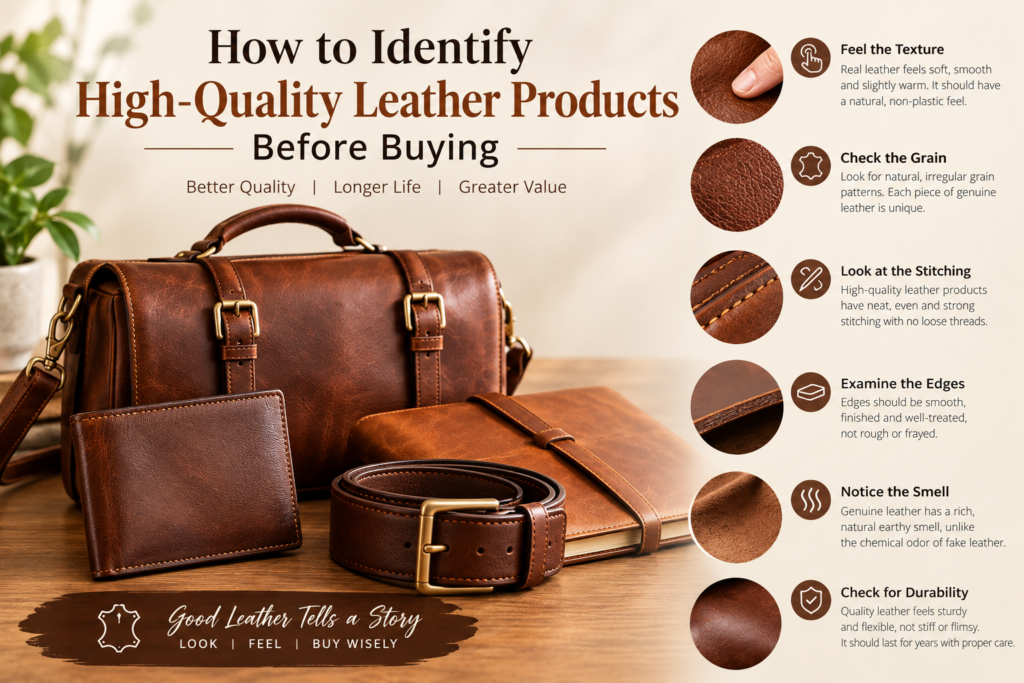
Natural leather can show variations in grain and texture.
A completely uniform surface may indicate a heavily processed or synthetic material, although appearance alone cannot reliably determine material composition.
Look for a finish that appears consistent with the product’s design.
Inspect the Stitching
Stitching is one of the easiest areas to inspect.
Look for:
- Even stitches
- Secure thread
- Clean corners
- No loose threads
- Reinforced stress points
On bags, pay special attention to handles and strap attachments because these areas experience repeated stress.
Check the Edges
Well-finished edges can make a noticeable difference.
Look for smooth, consistent edges without excessive roughness or unfinished areas.
For wallets and belts, inspect folded and exposed edges carefully.
Examine Hardware
Zippers, buckles, buttons and other hardware should feel appropriate for the product.
A belt with a weak buckle or a bag with poor-quality zippers may become inconvenient even when the leather itself looks good.
Look Inside the Product
For bags, inspect the lining, internal compartments and seams.
A product can look attractive externally while having poor internal construction. Good organization and durable internal stitching contribute to practical usability.
Check the Product Structure
A quality leather bag should maintain its intended shape without appearing unnecessarily stiff or poorly supported.
For wallets, check whether card slots and folding areas are neatly constructed.
For belts, inspect the buckle attachment and holes.
Consider Functionality
Quality is also about how the product works.
A wallet should provide accessible storage. A laptop bag should have suitable compartments. A handbag should be comfortable to carry.
A beautifully finished product that does not meet your practical needs may not be the right choice.
Ask About Manufacturing
When buying from a manufacturer, you can ask questions about the production process.
RVS International describes its manufacturing process as leather selection and cutting, shaping and stitching, followed by finishing and quality checking.
Understanding the manufacturing process can give buyers additional confidence when evaluating products.
Consider Long-Term Use
Think about how frequently the product will be used.
Daily-use products should be selected with extra attention to construction. A wallet carried every day experiences repeated folding and handling. A laptop bag may carry considerable weight.
Products intended for occasional use may have different requirements.
Don’t Judge Only by Price
Price can be influenced by many factors, including materials, construction, design, branding and manufacturing.
Instead of automatically choosing the most expensive option, compare the features and construction of the products you are considering.
Final Thoughts
Identifying high-quality leather products requires looking beyond surface appearance.
Check the material, stitching, edges, hardware, lining, structure and functionality. Most importantly, choose a product that matches how you intend to use it.
A careful inspection before buying can help you find a leather product that combines appearance, practicality and reliable construction.