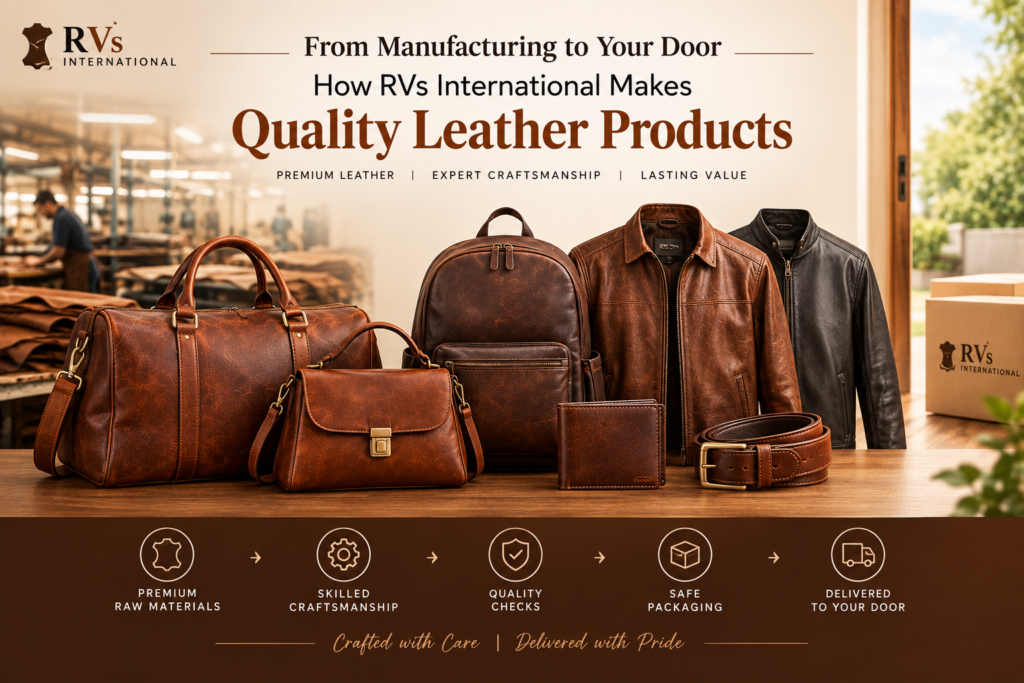
From Manufacturing to Your Door: How RVs International Makes Quality Leather Products
Leather Manufacturing Process: From Material to Finished Product
The leather manufacturing process involves several stages that transform selected leather materials into finished products such as wallets, bags, belts and accessories.
At RVS International, the manufacturing process described on the company website includes leather selection and cutting, shaping and stitching, followed by finishing and quality checks.
Understanding these stages helps customers appreciate the work involved in creating a finished leather product.
Step 1: Leather Selection
The process begins with selecting suitable leather for the product.
Different products may require different material characteristics. A wallet needs flexibility and precise construction, while a structured bag may require material with suitable strength and appearance.
Material selection should therefore consider the product’s intended use and design.
Step 2: Product Design
Before cutting begins, the product design must be established.
The design determines dimensions, panels, compartments, handles, straps and other components.
For custom products, specifications need to be clearly defined before manufacturing starts.
Step 3: Leather Cutting
Once the design and material are confirmed, leather is cut according to the required patterns.
Precision is important because incorrectly cut pieces can affect the final dimensions and appearance of the product.
RVS International identifies leather selection and precise cutting as the first stage of its manufacturing process.
Step 4: Shaping and Preparation
The individual leather pieces are prepared and shaped according to the product design.
Depending on the product, this may involve folding, reinforcing, adding components or preparing areas for stitching.
Good preparation helps create a clean final structure.
Step 5: Stitching
The prepared components are joined through stitching.
Stitching is particularly important because it contributes to the product’s structural strength and appearance.
Bags, wallets and belts all require careful stitching in areas that experience repeated use.
Step 6: Hardware and Components
Depending on the product, manufacturers may add zippers, buckles, buttons, rings, handles or other components.
These elements should be appropriate for the product and securely attached.
Hardware can influence both functionality and overall appearance.
Step 7: Finishing
After construction, the product receives its final finishing.
This can include polishing, dyeing or other finishing processes depending on the product design and material.
Finishing helps prepare the product for final inspection.
Step 8: Quality Check
Quality inspection is a critical final stage.
Manufacturers can inspect stitching, edges, hardware, dimensions, finishing and overall appearance.
RVS International specifically describes finishing and quality checking as the final stage of its listed manufacturing process.
Step 9: Packaging and Delivery
After the product passes inspection, it can be prepared for packaging and delivery.
For online customers, appropriate packaging helps protect products during transportation.
For business orders, packaging and logistics requirements can be discussed according to the order.
Manufacturing Different Leather Products
The basic manufacturing stages can vary depending on the product.
A wallet requires precise small components and folding areas. A laptop bag requires compartments and suitable protection. A belt requires accurate sizing, holes and buckle attachment.
RVS International’s product range includes wallets, belts, laptop bags, handbags, ladies bags, purses and backpacks.
Why Craftsmanship Matters
Manufacturing leather products is not simply about joining pieces of material.
Design, precision, stitching, finishing and inspection all contribute to the final result.
Small details can influence how comfortable, functional and attractive a product becomes.
From Manufacturer to Customer
The finished product represents the combination of material selection, design, production and quality control.
Whether the product is purchased individually through an online store or sourced for a larger business requirement, understanding the manufacturing process provides useful insight into what goes into the final product.
Final Thoughts
The leather manufacturing process involves multiple carefully connected stages, from selecting suitable material to cutting, shaping, stitching, finishing and quality inspection.
At RVS International, these steps form part of the company’s stated approach to producing leather goods. For customers and businesses, understanding the process can make it easier to evaluate products and communicate their requirements when purchasing or developing leather goods.